
Cribden House School
Modern Foreign Languages
Modern Foreign Languages at Cribden House introduce pupils to Spanish in a fun, practical and engaging way. Children learn to communicate with confidence, explore a new culture and develop an awareness of life beyond their own community. Spanish was chosen because it is the second most spoken language in the world, offering pupils a valuable and meaningful connection to the wider world.
The curriculum focuses on building key communication skills: listening, speaking, reading and simple writing. Lessons are interactive and memorable, using songs, stories, games, role play and digital resources to help children understand and use real Spanish vocabulary and phrases.
Learning Spanish supports much more than language alone—it builds confidence, social interaction, memory skills, cultural awareness and a curiosity about life in other countries.
Who learns MFL?
MFL is taught to pupils who are:
-
working at Key Stage 2 ability
-
on the Thinking Pathway
Pupils study Spanish weekly as part of the formal curriculum, following a structured and progressive long-term plan.
What children learn
Across Key Stage 2, pupils develop the foundations of simple communication in Spanish. They learn to:
-
greet others and hold simple conversations
-
talk about themselves, their likes, families and routines
-
respond to questions and give short answers
-
explore numbers, colours, weather, food, animals and classroom language
-
use vocabulary and sentence structures in context
-
listen carefully, copy pronunciation and build confidence speaking aloud
Children also explore Spanish culture, festivals, food, traditions and everyday life, helping them develop respect and curiosity for the wider world.
How Spanish is taught
Lessons are:
-
practical and interactive
-
supported with visuals, songs, games and role play
-
differentiated so every learner can take part
-
linked to real-life situations
Activities may include:
-
speaking practice in pairs or small groups
-
vocabulary games and memory challenges
-
song and music-based learning
-
digital activities using apps or language tools
-
simple reading and writing tasks for those able
Pronunciation, repetition and recall are taught through playful, confidence-building activities.
Curriculum Progression
The Spanish curriculum is sequenced so knowledge builds over time. Themes include:
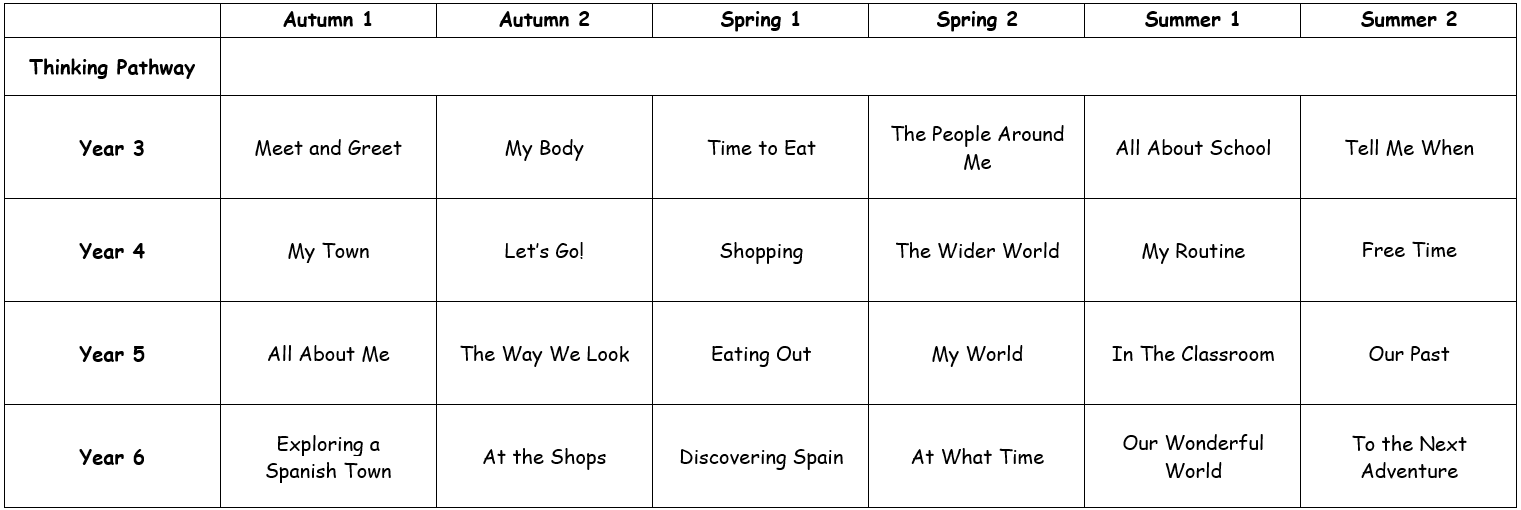
As pupils progress, they revisit and extend vocabulary while developing clearer pronunciation, sentence building and the confidence to communicate.
Assessment
Progress is assessed through:
-
practical activities
-
speaking and listening responses
-
games, role play and vocabulary recall
-
simple written work where appropriate
-
teacher observation and questioning
Assessment focuses on communication, confidence and the ability to apply language in context—rather than accuracy alone.